Why Salesforce Sharing Rules Are Holding Your Org Back
If you have worked in Salesforce for any length of time, you have almost certainly hit the wall with sharing rules. They get you so far — and then you are left writing Apex, stacking up criteria-based rules, or calling in an architect to untangle something that should have been simple from the start.
That is exactly the problem that FormulaShare was built to solve. And in the first session of our Punjabiforce AppExchange Series — FormulaShare Unplugged — we sat down with Lawrence Newcombe, the founder of Cloud Sundial and the brain behind FormulaShare, to find out what it does, who it is for, and why it is worth having in your toolkit.
“The first use case we really supported is sharing based on formula values on objects. It sounds simple. But look on the Idea Exchange — this has been requested for longer than I have been in Salesforce. It is such a game changer.” — Lawrence Newcombe
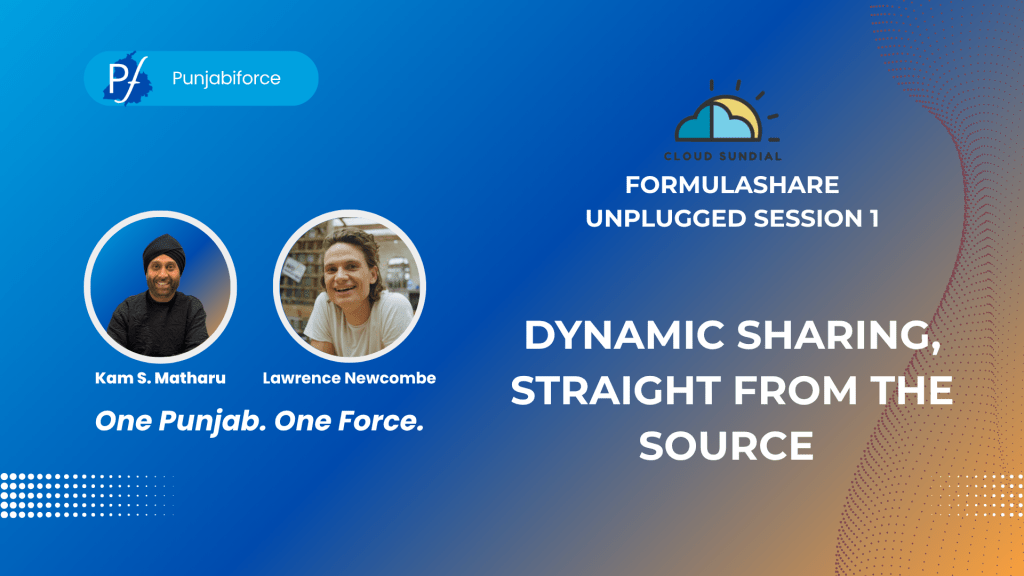
The Guest: Lawrence Newcombe, Cloud Sundial
Lawrence Newcombe has been working in the Salesforce ecosystem for over 13 years. He came in through business analysis, working with NGOs and broadcast technology organisations, before the recurring problem of complex sharing requirements pushed him to build something the ecosystem did not yet have.
FormulaShare started as an open source project — a genuine response to a genuine gap. Seven years on the AppExchange later, it has evolved into a fully managed product under Cloud Sundial, with a free tier, enterprise paid tiers, and a partner programme. Lawrence was Punjabiforce’s inaugural AppExchange guest, and his willingness to sit down, share the journey, and explain the product in plain language made for exactly the kind of session Kam had envisioned.
As Lawrence put it himself when Kam welcomed him: he was honoured to be the inaugural AppExchange guest, and he hoped to do it justice. He did.
The Host: Kam Matharu
Kam’s mission is straightforward: make the knowledge accessible. Not just the Salesforce platform — but the wider ecosystem. The ISV tools, the AppExchange products, the career paths that most training courses never even mention. The FormulaShare Unplugged series is a direct expression of that mission.
So What Is FormulaShare?
In Lawrence’s own words: FormulaShare makes sharing easier. Salesforce’s native sharing mechanisms are solid — up to a point. But they have hard limits, and those limits tend to surface at the worst possible time, usually when your org is growing, your data model is maturing, and the business is asking for something that native rules simply cannot deliver cleanly.
FormulaShare sits on top of your existing Salesforce org and lets you configure dynamic, formula-driven sharing rules through a click-and-configure interface. No Apex. No custom code. No architectural debt that walks out the door when a developer leaves. Rules are transparent, auditable, and manageable by any trained admin or consultant.
“FormulaShare is all about making sharing easier. Salesforce sharing gets you so far — and then you are on your own. We take the use cases that would need advanced, potentially less stable customisation and make them click-and-configure.” — Lawrence Newcombe
For those who prefer the managed AppExchange experience, FormulaShare has three tiers:
- Free (Light) tier — install directly into any org including production, no sign-up required. You get the vast majority of FormulaShare’s features with limits on the number of rules and record volume (up to 10,000 records). Enough for many real-world use cases, and used by some quite substantial organisations.
- Paid tiers — for larger organisations with enterprise-scale sharing requirements.
- Partner programme — for SIs and consulting firms who want to build FormulaShare into their practice and offer it to clients, with full enablement support.
That open architecture also builds trust. Lawrence explained that being able to show customers exactly how the product is designed — in the code — gives them confidence in a way that a black-box product simply cannot.
The Three Limitations FormulaShare Solves
- Sharing Cannot Follow Related Object Data
- The 50 Criteria-Based Sharing Rule Limit
- The Fragility of Custom Apex Sharing
Cross-Object Sharing in Practice
One of Kam’s sharpest questions in the session was about cross-object sharing — the kind of scenario every BA and consultant has encountered where the business logic is perfectly clear but the native tools cannot support it.
Lawrence’s example: imagine you want to share product records with users who are connected to accounts via opportunities, and linked through the child opportunity products that tie those two things together. FormulaShare lets you map that entire relationship path through a UI, lookup by lookup, and use it as the driver for sharing. No code. No flow. No Apex trigger. Just configuration.
“We allow admins to configure what the relationship is from the shared object to the object that drives the sharing — through a series of lookup relationships that can go up, down through the data model. Those sorts of use cases where there is quite an involved relationship — we have an interface that lets you just map it in.” — Lawrence Newcombe
Who Is It Built For?
FormulaShare works on all standard shareable objects — accounts, opportunities, orders, campaigns, and more — as well as any custom object with its own independent sharing model. The main exceptions are objects like contracts and tasks which follow Salesforce’s own quirks in their access model, but Lawrence was clear those are rare edge cases.
Industries that have found a particularly strong fit:
- Healthcare — managing visibility of patient records and communications across care teams and partner organisations, where GDPR and access control are business-critical
- Legal — strict rules about who sees what, driven by case and matter data
- Non-profits — complex sharing models for volunteers, staff, and delivery partners; FormulaShare offers a significant non-profit discount and counts many non-profits among its most engaged customers
- Public sector and recruitment — managing access across both internal users and community or partner users
Kam made the GDPR point during the session and Lawrence confirmed it directly: in a world where data visibility and access control are regulatory requirements, not just best practice, a tool that makes sharing auditable and configurable without code is not a nice-to-have. It is increasingly essential.
The Career Opportunity — And Why Punjabiforce Is Talking About It
This is the part that sits at the heart of what Punjabiforce does. Kam put it plainly during the session: there are jobs available in FormulaShare. If you become an expert in a product like this, you have options. You can freelance. You can contract. You can be the go-to person inside your organisation. You can join Cloud Sundial’s partner ecosystem.
The AppExchange is enormous. There are hundreds of category-defining ISV tools installed across thousands of Salesforce orgs. The professionals who understand those tools deeply — not just the platform but the ecosystem on top of it — are genuinely hard to find. That gap is a career opportunity.
- As a freelancer or contractor, FormulaShare expertise positions you for high-demand, low-competition niche implementations
- As a consultant in an SI or partner firm, knowing the right AppExchange tool for the right problem makes you a better architect
- As a permanent hire in an end-user org running FormulaShare, governing the sharing model is a high-visibility, business-critical function
Lawrence confirmed the partner programme exists precisely because Cloud Sundial wants trained people in the ecosystem who can implement FormulaShare well. The demand is there. The supply of experts is not.
Punjabiforce exists to close gaps like this. Not just in knowledge — but in access to knowledge. The AppExchange Series is about making the ecosystem visible to the people who deserve to be in it.
Watch the Full Session
FormulaShare Unplugged — Session 1 is live now on the Punjabiforce YouTube channel. Watch it, share it with your team, and let us know what you think.

 Kam's Tech Talk - Learn. Connect. Thrive.